
Saddle-Stitched Booklets: A Simple, Professional Solution for Small Publications
As a small print shop, one of the most common – and most versatile – projects we produce are saddle-stitched booklets. Whether it’s a program for an event, a product catalog, a community newsletter, or a training guide, saddle stitching is often the perfect binding choice for short- to medium-length booklets. It offers a clean, professional look without the higher cost or long turnaround associated with more complex binding methods.
Today, we’re breaking down the three key things we always talk through with our clients: the benefits of saddle stitching, the difference between a self-cover and a plus cover, and why page count really does have to be divisible by four.
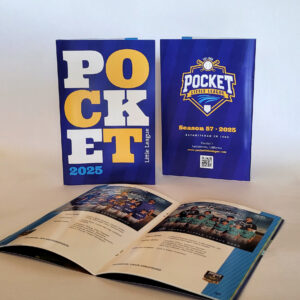
The Benefits of Saddle Stitching
Saddle stitching is one of the most popular booklet-binding methods—and for good reason.
- Cost-Effective
Because saddle stitching uses folded sheets and simple metal staples (rather than adhesive or wire coils), it’s one of the most affordable binding options. This makes it ideal for budget-friendly marketing materials, short-run print projects, or publications that are updated frequently.
- Fast Turnaround
With fewer production steps involved, saddle-stitched booklets can move quickly from design to finished product. This is especially helpful for events, seasonal materials, or last-minute updates.
- Professional, Clean Look
Even though it’s economical, saddle stitching still produces a polished, high-quality finish. The booklet lies fairly flat when opened, making it easy to read and ideal for instructional content, menus, and reports.
- Great for Small to Medium Page Counts
Saddle stitching works best for booklets ranging from 8 to around 64 pages, depending on paper thickness. It keeps the booklet lightweight and compact without compromising durability.
Self-Cover vs. Plus Cover: What's the Difference?
When planning a booklet, one of the first decisions we help clients make is whether they want a self-cover or a plus cover (sometimes called a heavy cover).
Self-Cover Booklets
A self-cover booklet uses the exact same paper stock for the cover as the inside pages.
Best for: newsletters, multi-page flyers, programs, or booklets that need to stay lightweight and flexible.
Benefits:
- More economical
- Smooth, seamless look
- Thinner overall booklet
- Faster to produce
Plus Cover (Heavy Cover) Booklets
A plus cover includes a separate, heavier paper stock for the front and back covers.
Best for: catalogs, product guides, manuals, or any booklet that needs a more durable, premium feel.
Benefits:
- Added sturdiness and protection
- More visual impact
- Ideal for booklets that will be handled frequently
- Can be coated or finished differently from the inside pages
We always encourage customers to think about how the booklet will be used. If it’s a one-time event program, a self-cover is usually perfect. If it’s something that needs longevity—like a mini-catalog or a reference guide—a plus cover makes a big difference.
The Page Count Rule: Must Be Divisible by Four
One of the most important—and often surprising—things clients learn about saddle stitching is that the total page count must be divisible by four.
Why? Because saddle stitching uses sheets of paper that are folded in half, creating four pages per sheet:
- Front of the sheet = 2 pages
- Back of the sheet = 2 pages
When we collect and nest the sheets together, the booklet can only be built in increments of four (8, 12, 16, 20, and so on).
If your design ends up with, say, 22 pages, we can’t saddle stitch it as-is. We’ll either need to:
- Add two blank pages,
- Adjust layout to consolidate or expand content, or
- Explore a different binding method if your page count gets too high.
This is why we always recommend clients consider their page count early in the planning process—it saves time, prevents last-minute changes, and ensures the final booklet prints perfectly.
Wrapping Up
Saddle-stitched booklets are one of the most practical and cost-effective ways to create clean, professional printed materials. By understanding the benefits, choosing the right cover style, and planning your page count in multiples of four, you can ensure your booklet looks great and functions exactly as intended.
If you’re thinking about creating a booklet for your next project, we’re always here to help you choose the best options and guide you through the process from start to finish.
At Calico Creative, we specialize in producing high-quality saddle-stitched booklets for businesses, organizations, and events throughout Sacramento and the surrounding areas. Whether you need a short run of programs for a local event or a polished catalog for your business, our team can guide you through every step, from paper selection and cover options to page-count planning and final finishing. With fast turnaround times, attention to detail, and a commitment to craftsmanship, we make it easy to get professional, affordable booklets printed locally and delivered with care. If you’re looking for reliable booklet printing in Sacramento, Calico Creative is here to help bring your project to life.
-
 Booklets
Perfect Bound Books
Select options This product has multiple variants. The options may be chosen on the product page -
 Booklets
Gloss Saddle-Stitched Booklets
Select options This product has multiple variants. The options may be chosen on the product page